 St. Mina of Egypt, also known as Menas, was a martyr and wonder-worker who holds a significant place among Coptic saints in both the East and the West. His life is marked by devotion, miracles, and unwavering faith.
- Origin of His Name:
- Menas was his original name, bestowed upon him by his mother. She heard a voice saying “amēn,” leading her to name her son Menas. In Greek and Armenian, he is known as Minas, while in Coptic, he is referred to as Mīna.
- Life and Martyrdom:
- Born in Egypt around 285 CE, Menas hailed from the city of Nikiou, near Memphis. His parents were devout Christians who had longed for a child. On the feast of the Virgin Mary, Euphemia, Menas’ mother, tearfully prayed before an icon of the Virgin, asking for a son. The icon responded with a resounding “Amen.”
- A few months later, Euphemia gave birth to a boy and named him Menas. His father, Eudoxios, held a prominent position in Egypt’s administration.
- At the age of fifteen, Menas joined the Roman army, where he rose to a high rank due to his father’s reputation.
- Witnessing the persecution of Christians, Menas became even more devoted to his faith. When pressured to recant his Christian beliefs, he refused, leading to his martyrdom.
- Feast Day and Veneration:
- Menas’ commemoration is commonly observed on November 11 (which corresponds to November 24 on the Julian calendar). His feast day is celebrated on 15 Hathor in the Coptic Orthodox Church of Alexandria (equivalent to November 24 on the Gregorian Calendar).
- In Eastern Orthodox churches following the old style or Julian calendar, it is also celebrated on November 24. In churches following the new style or Revised Julian calendar, as well as in the Catholic Church, it is observed on November 11.
- Attributes and Patronage:
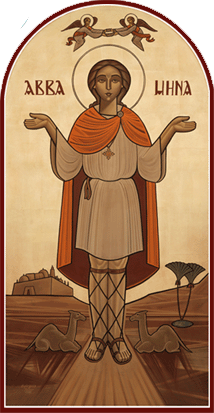
- Menas is depicted as a Christian martyr with his hands cut off and eyes torn out. Other representations include a man with two camels or a young knight with a halberd (an anachronistic depiction of his time in the Roman army).
- He is the patron saint of falsely accused people, peddlers, traveling merchants, and the city of Heraklion.
- Monastery of Saint Mina:
- The Monastery of Saint Mina in Egypt houses the relics of Saint Mina and those of Pope Cyril VI of Alexandria.
- Legacy:
- St. Mina’s unwavering faith, miraculous intercession, and enduring veneration continue to inspire believers across generations.
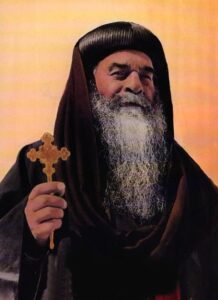 Pope Kyrillos VI, also known as Saint Cyril VI of Alexandria, was born on August 2, 1902, in Damanhour, Egypt, with the name Azer Youssef Atta. He came from a devout Christian family and exhibited a strong faith from an early age. At the age of 19, he entered the Monastery of St. Mina in Mariut, Egypt, where he pursued a life of prayer, study, and asceticism.